
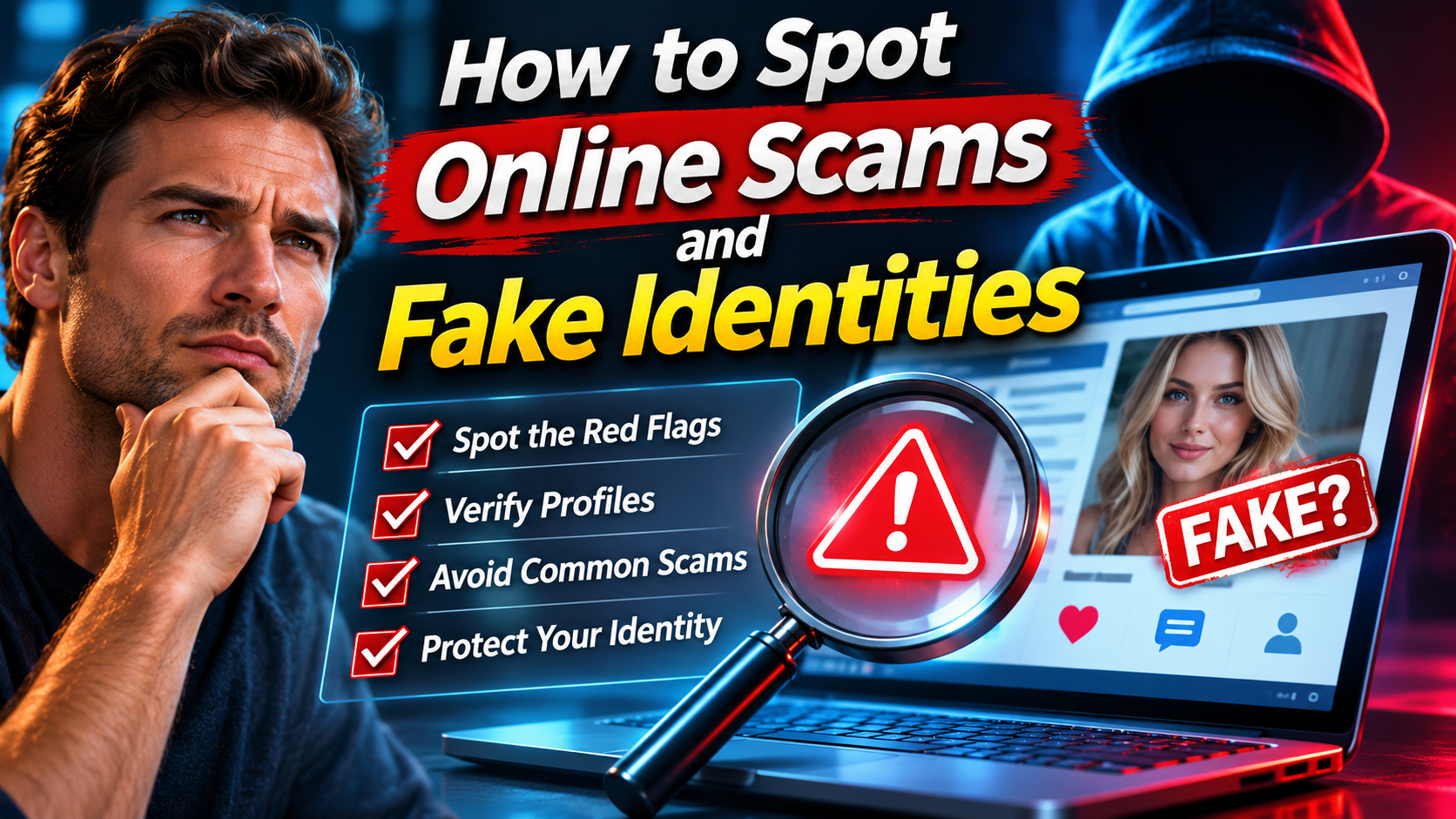
Key Takeaways:
- Learn how to spot online scammers by recognizing 15 common warning signs.
- Discover how to identify fake profiles and verify online identities safely.
- Understand the tactics behind online dating scams, romance fraud, and AI-generated fake identities.
- Protect your personal information and finances by recognizing suspicious requests and avoiding common online scams.
- Know what steps to take if you encounter a scammer or become a victim of online fraud.
Online scammers are getting better at looking like real people. From convincing social media accounts to fake dating profiles and AI-generated photographs, knowing how to spot a scammer online and how to spot a fake profile has become an essential digital safety skill.
A friendly message, professional-looking photograph, or seemingly genuine conversation can sometimes hide an attempt to steal money, personal information, or access to your accounts.
The good news? Most online scams still leave clues. Some are obvious, while others become noticeable only when you know what to look for. This guide explains how to recognize fake online identities, verify whether someone is genuine, identify common online dating scams, and protect yourself before a suspicious interaction becomes a costly mistake.
How to Spot a Scammer Online: 15 Warning Signs
Scammers rarely announce themselves with an obvious fraudulent message. Instead, they often begin with ordinary conversations, attractive profiles, or believable explanations designed to earn your trust. Their goal is to make you feel comfortable enough to overlook warning signs when they eventually ask for something.
Although no single behavior proves someone is dishonest, patterns can reveal a great deal. The following 15 warning signs can help you recognize suspicious accounts across dating platforms, social networks, messaging apps, professional communities, and live-streaming services.
1. Their profile photographs look suspiciously perfect
Scammers may use stolen photographs, heavily edited images, stock photography, or AI-generated faces to create attractive online identities. A polished photograph isn't evidence of fraud, but it deserves closer attention when the profile contains little supporting information.
Try a reverse image search using Google Lens or TinEye. If the same photograph appears under several unrelated names, that is a strong reason to question the account.
2. They quickly try to establish an emotional connection
A stranger who expresses intense affection or unusually strong emotional attachment after a few conversations may be using a tactic called love bombing.
Romance scammers often accelerate emotional intimacy to make future requests seem reasonable. Genuine relationships can develop quickly, too, so look for additional warning signs rather than relying on speed alone.
3. They avoid reasonable identity verification
Someone who repeatedly refuses a video conversation, provides inconsistent explanations about their identity, or cannot answer ordinary questions about their supposed background may be hiding something.
However, privacy-conscious people may legitimately avoid video calls. Verification should always be voluntary, respectful, and based on several indicators rather than a single demand.
4. Their personal story keeps changing
A scammer may claim to work overseas, travel frequently, serve in the military, or hold a demanding professional position.
Pay attention when basic facts about their job, location, age, or circumstances change without a reasonable explanation. Repeated contradictions can indicate a fabricated identity.
5. They ask for money, gift cards, or cryptocurrency
This is one of the strongest signs of an online scammer, especially when the request comes from someone you have never met.
Fraudsters may invent medical emergencies, transportation problems, frozen accounts, or investment opportunities. Requests involving cryptocurrency, wire transfers, or gift cards deserve particular caution because recovering funds can be difficult.
6. They pressure you to act immediately
Messages such as "You must send this today" or "Don't tell anyone about this" are designed to discourage independent thinking.
Urgency is common in impersonation scams, account-security scams, fake prize notifications, and romance fraud.
7. Their profile contains little credible history
An account with almost no activity, generic descriptions, limited interactions, and recently uploaded photographs may be suspicious.
Nevertheless, a new or private account is not automatically fake. Look for combinations of inconsistent details, unsolicited requests, and unusual behavior.
8. They send unexpected links or attachments
Suspicious links may direct you to counterfeit login pages, fraudulent payment portals, or websites designed to collect personal information.
Instead of opening an unexpected link, navigate directly to the company's official website or application.
9. They insist on moving conversations to another platform
Online dating scammers sometimes attempt to move conversations from a dating service to private messaging applications.
There are legitimate reasons to change platforms, but an immediate insistence on doing so can be concerning, particularly when accompanied by secrecy or financial requests.
10. Their messages seem generic or repetitive
Some fraudulent accounts use scripted conversations or automated messages that could apply to almost anyone.
Watch for replies that ignore your questions, repeat earlier statements, or abruptly change subjects. AI-assisted messaging can make these patterns less obvious, so message quality alone is not reliable proof.
11. They claim to represent a trusted organization
Scammers frequently impersonate banks, delivery companies, technical support representatives, government agencies, and recognizable online platforms.
A logo, official-sounding title, or familiar company name does not establish authenticity. Contact the organization through independently verified channels.
12. They request sensitive personal information
Requests for passwords, one-time security codes, financial account numbers, identification documents, or private photographs should raise immediate concern.
Legitimate organizations generally do not need you to disclose your password or authentication codes to a person contacting you unexpectedly.
13. They promise unrealistic financial returns
Someone offering guaranteed profits, secret investment opportunities, or unusually high returns with little risk may be promoting investment fraud.
These schemes sometimes begin as friendly conversations before introducing cryptocurrency trading, fake investment dashboards, or fabricated success stories.
14. They become defensive when questioned
A dishonest person may react to ordinary verification questions with anger, guilt, threats, or emotional manipulation.
A genuine person can also feel uncomfortable being questioned. The more important warning sign is a repeated attempt to prevent you from independently checking important claims.
15. They create an emergency that only you can solve
One common manipulation technique involves inventing a crisis that supposedly requires your immediate financial assistance.
The situation may involve a sick relative, travel expenses, an unexpected legal problem, or a frozen bank account. The details vary, but the pressure to send money quickly is often the same.
How to Spot a Fake Profile and Identify Fake Online Identities
A fake profile is an online account that misrepresents the identity of the person or organization behind it. Some are harmless parody accounts, while others are created to impersonate real people, deceive potential romantic partners, distribute spam, or commit financial fraud. Understanding the difference is important because an unfamiliar or anonymous profile is not necessarily malicious.
The challenge is that fake accounts can appear remarkably authentic. They may contain photographs, personal histories, regular posts, and conversations that seem entirely natural. The most effective approach is to evaluate several independent pieces of information rather than trusting a photograph, a verification badge, or an engaging personality.
How to tell if an online profile is fake
Begin by examining the account's overall consistency. Does its biography match the person's claimed interests and location? Do posts and photographs tell a coherent story? Does the account have meaningful interactions, or does nearly everything look recently assembled?
A practical profile-checking process includes:
· Photographs: Search profile images for evidence of impersonation or reuse.
· Account history: Review the timing and consistency of public activity.
· Biography: Look for contradictions between stated facts and subsequent conversations.
· Social interactions: Consider whether comments and connections appear natural, while remembering that engagement can be fabricated.
· External claims: Independently verify employment, business affiliations, or professional credentials when relevant.
· Requests: Be particularly cautious when an account unexpectedly asks for money, confidential information, or access to other services.
A fake profile may pass several of these checks. Conversely, a genuine user with strong privacy settings may fail them. The goal is to identify meaningful inconsistencies, not judge someone by how much information they choose to share.
How to identify a fake person online without invading their privacy
Suppose someone claims to be a photographer living in Chicago. Their profile contains professional photographs, and they mention an upcoming exhibition. Rather than demanding identification documents, you could search for the exhibition through its official organizer or check whether the professional details they voluntarily share are consistent.
This method helps distinguish between verifying a claim and collecting unnecessary personal information.
Avoid searching for private addresses, contacting someone's relatives, or pressuring a stranger to disclose sensitive documents. A person's willingness to protect their privacy should not automatically make them suspicious.
Online Dating Scams: How Romance Scammers Build Trust
Online dating scams often begin with conversations that seem ordinary, enjoyable, and emotionally rewarding. A scammer may spend days or weeks learning about someone's interests, daily routine, financial circumstances, and relationship goals before introducing a fraudulent request. This gradual approach makes the eventual deception harder to recognize.
According to the Federal Trade Commission, nearly 60% of people who reported losing money to romance scams in 2025 said the interaction began on social media. That finding reinforces an important point: romance fraud is not confined to dating apps. It can begin almost anywhere people connect online.
The typical progression of an online dating scam
Although every situation differs, many romance scams follow a recognizable pattern.
Initial contact and attraction
The scammer introduces an appealing identity and begins a friendly or romantic conversation.
Trust and emotional attachment
Frequent messages, personal stories, and promises of a future relationship create familiarity.
Isolation and dependence
The scammer may discourage outside opinions, move communication elsewhere, or repeatedly avoid meeting.
Financial or personal exploitation
A fabricated emergency, investment proposal, or request for sensitive information becomes the objective.
The FBI warns that criminals commonly use fabricated identities to develop romantic trust before seeking money or other benefits. They may claim to work abroad, experience an unexpected crisis, or need financial assistance to arrange a meeting.
Staying safe while meeting people online
Whether you use mainstream dating applications, social communities, or adult-oriented platforms, the same safety principles apply. Keep early conversations within the platform when practical, avoid sharing sensitive financial details, and never assume that an appealing profile guarantees someone's identity.
People exploring communities such as adult friendfinder should take time to understand available privacy controls and reporting features before interacting with unfamiliar members.
Likewise, visitors using live cam sites should distinguish legitimate platform payment features from unexpected personal requests made outside official payment systems.
A genuine connection should not require you to compromise your financial security or ignore your personal boundaries.
AI-Generated Fake Identities and Deepfake Scams
Artificial intelligence has changed the way criminals create and operate fake online identities. In the past, a scammer might have needed to steal someone's photograph or manually write hundreds of deceptive messages.
Today, generative AI can help produce realistic faces, convincing biographies, personalized conversations, and synthetic audio.
These developments make older scam-detection advice less dependable. Awkward grammar, obviously stolen photographs, and inconsistent writing styles are no longer reliable indicators on their own.
The FBI's 2025 Internet Crime Report recorded 22,364 complaints involving AI-related information, with reported losses exceeding $893 million. These figures cover multiple types of AI-related crime, not exclusively fake profiles or romance fraud.
Can scammers use AI to create convincing photographs?
Yes. AI image generators can produce realistic-looking people who do not exist. A reverse image search might find nothing because the photograph was generated rather than copied from another website.
Some synthetic images contain visual inconsistencies, but these clues are not dependable. Instead of focusing on unusual fingers, lighting, or facial features, consider whether the person's identity and behavior can be independently verified.
Can a scammer fake a video call or voice message?
Yes. Voice cloning, prerecorded material, and AI-generated video can be used to impersonate someone. The FBI has specifically warned that synthetic videos and audio may be used to make fraudulent identities appear legitimate.
A live video conversation can provide useful context, but it should not be treated as definitive proof of identity. For high-stakes situations involving money or sensitive information, confirm claims through a separate trusted channel.

Common Online Scams and How They Differ
Not every online scam begins with a romantic conversation or fake personal profile. Fraudsters also impersonate companies, create fraudulent stores, distribute deceptive employment offers, and establish fake investment opportunities.
Knowing the different methods helps you recognize threats even when the circumstances are unfamiliar.
Many schemes share the same underlying strategy: establish credibility, introduce a reason to act, and make it difficult to verify the request independently. Understanding that sequence is more useful than memorizing individual scam stories.
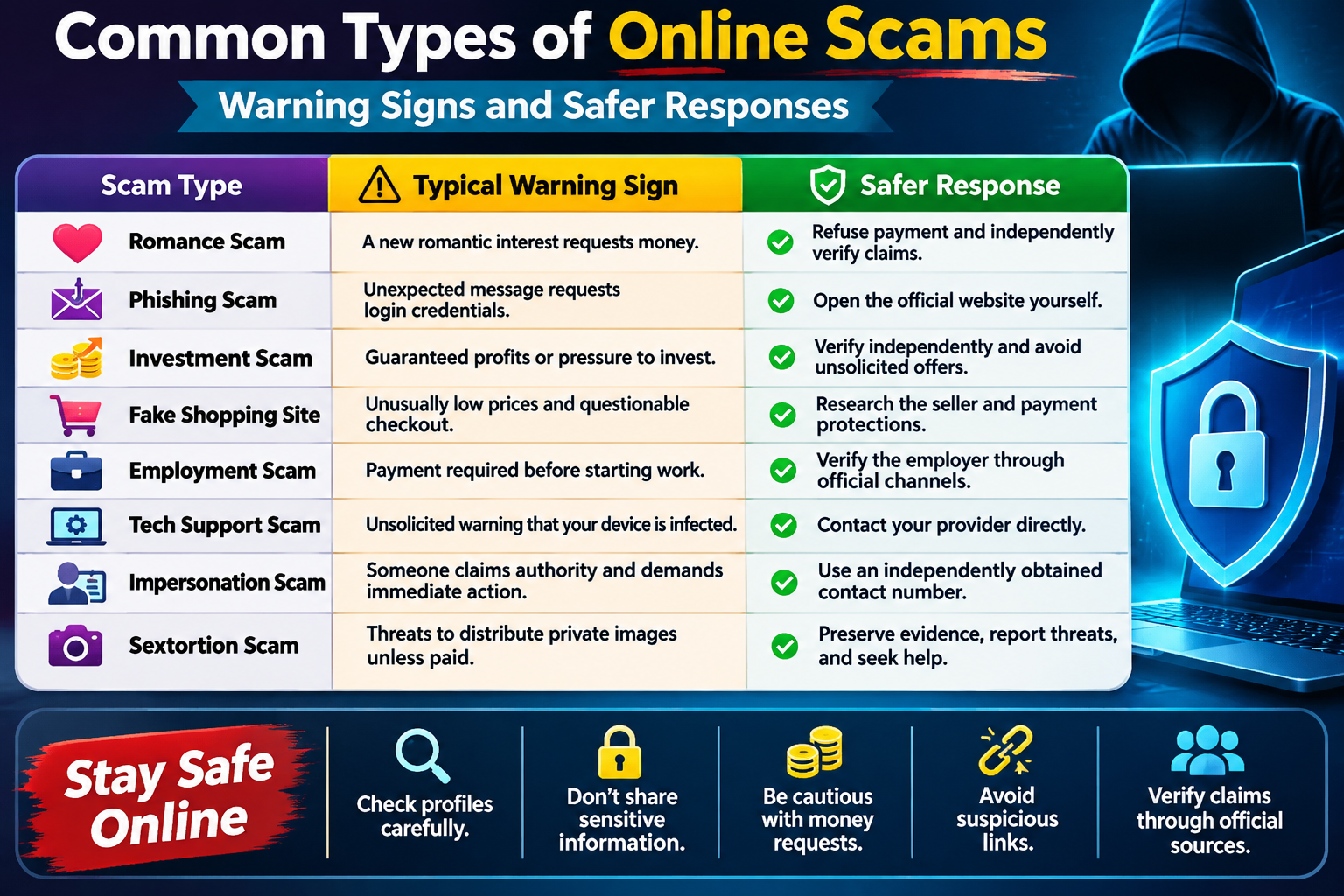
These categories can overlap. For example, a romance scammer may eventually introduce a fraudulent investment opportunity, while an impersonator may send phishing links designed to steal account credentials.
Why relationship investment scams deserve special attention
One particularly damaging variation combines emotional manipulation with investment fraud. A person you meet online develops a friendly or romantic relationship, then casually mentions their success trading cryptocurrency or investing through a supposedly exclusive platform.
They may show screenshots of profits, introduce a helpful financial contact, or encourage a small initial deposit. A fraudulent platform might even display fabricated gains or permit a limited early withdrawal to create confidence.
The U.S. Department of Justice warned in February 2026 that criminals use dating apps, social networks, and messaging services to build trust before directing victims toward fake cryptocurrency or trading platforms.
The essential rule: Do not allow someone you know only through an online relationship to become your investment adviser, regardless of how trustworthy or successful they appear.
How to Avoid Online Scams Before They Happen
Preventing fraud is generally easier than recovering from it. The most effective protections are not complicated, but they do require consistency. Strong account security, careful information sharing, and independent verification can prevent many common attacks.
It is also important to recognize that online safety does not mean avoiding new people or unfamiliar websites altogether. The objective is to participate confidently while maintaining boundaries that make deception less likely to succeed.
Protect your accounts and personal information
Use a unique password for every important account, preferably generated and stored through a reputable password manager. Enable multi factor authentication, with passkeys or authenticator applications where supported.
Review the privacy settings on your social media, dating, and communication accounts. Information such as your birthday, workplace, location, relationship status, and travel plans can help scammers create personalized messages.
Be cautious about publicly sharing details that could be used to answer account-recovery questions or impersonate you.
Keep payments inside legitimate platform systems
When using online marketplaces, subscription services, or entertainment platforms, prefer their established payment systems rather than sending money directly to an unfamiliar individual.
For example, visitors browsing webcam sites should review the service's official payment and account-security procedures rather than trusting someone who directs them to an unrelated payment link.
An official payment system is not a guarantee against every problem, but moving payments outside a platform can eliminate protections or make a transaction harder to investigate.
Build a personal verification routine
Before trusting an unfamiliar online contact, ask yourself three questions:
·
Can I verify what this person claims?
Look for independent confirmation rather than evidence supplied entirely by the person.
·
What are they asking me to risk?
Consider money, personal information, account access, reputation, and emotional well-being.
·
Would the request still make sense without urgency or emotional pressure?
A legitimate request should usually withstand reasonable scrutiny.
If something feels questionable, stop the interaction temporarily. You do not owe an unfamiliar person immediate access to your time, money, or personal information.
How to Tell if Someone Is a Scammer:
A Practical Verification Checklist
When an online interaction feels suspicious, it can be difficult to decide whether to continue, investigate, or stop communicating. A structured checklist helps you separate observable facts from assumptions and emotions. It also reduces the temptation to rely on a single clue, such as an attractive photograph or a recently created account.
The following checklist is a practical decision aid, not a scientifically validated fraud score. It is designed to help you recognize escalating risk and decide when additional verification is appropriate.
Suspicious profile checklist
Their identity or personal story contains significant contradictions.
They repeatedly avoid reasonable, voluntary verification.
They ask for money, cryptocurrency, gift cards, or account access.
They create urgency, secrecy, guilt, or emotional pressure.
Their photographs or credentials appear connected to another identity.
They send unexpected payment, login, or download links.
They discourage advice from trusted friends or family.
They insist on using unofficial payment or communication channels.
Select any warning signs you have noticed. Even one serious warning can justify stopping an interaction.
This checklist does not establish whether an account is fraudulent. Avoid sending sensitive evidence to unverified third parties.
What if an account looks real but something still feels wrong?
A convincing profile can belong to a scammer, and a minimal profile can belong to a legitimate person. The important question is not simply whether the account looks authentic, but whether the person's claims, actions, and requests remain consistent over time.
For example, a person may willingly participate in a video call yet later request money for an unverifiable emergency. The video call does not make the financial request safe. Treat each new request on its own merits, even when earlier interactions seemed reassuring.
Discovering that someone may have deceived you can be upsetting, particularly if the interaction involved a close personal connection. It is common to feel embarrassed, angry, or uncertain about what happened. Those emotions can make it difficult to decide what to do next.
Acting promptly matters because some payment providers can potentially stop transactions, and compromised accounts may remain vulnerable until their security settings are changed. The correct response depends on whether you shared information, sent money, opened a suspicious link, or experienced threats.
Steps to take immediately
1.
Stop communicating with the suspected scammer. Do not send additional money or respond to demands for secrecy.
2. Contact your financial institution or payment provider. Explain that you suspect fraud and ask whether a transaction can be reversed, recalled, or disputed.
3. Secure compromised accounts. Change affected passwords using a trusted device, revoke unfamiliar sessions, and enable stronger authentication.
4. Preserve relevant evidence. Save messages, usernames, transaction references, and screenshots without redistributing sensitive material.
5. Report the account to the platform. Use its fraud, impersonation, or abuse reporting process.
6. Report the incident to authorities. In the United States, reports can be submitted through the FTC's ReportFraud.gov or the FBI's Internet Crime Complaint Center at IC3.gov.
7. Be alert for recovery scams. Criminals sometimes contact previous victims while pretending they can recover lost money for an advance fee.
The FBI recommends reporting suspected internet fraud promptly and documenting the people involved, methods of contact, payment details, and relevant interactions.
What if someone threatens to share private photographs?
If someone threatens to distribute intimate images or private information, avoid negotiating or paying. Payment does not guarantee that the threats will stop.
Preserve appropriate evidence, report the account, and consider contacting law enforcement. If intimate images are involved, specialized services such as StopNCII.org for adults and Take It Down for eligible images taken before age 18 may help limit distribution on participating platforms.
Do not forward intimate images to strangers offering investigative or removal services. If you are concerned about your immediate safety, contact local emergency services.
How to Stay Safe Online Without Losing Trust in Genuine People
Learning how to spot online scams is not about assuming every unfamiliar person has dishonest intentions. Most everyday online interactions are legitimate, and digital communities can create meaningful friendships, professional relationships, and romantic connections.
The challenge is finding a sensible balance between openness and caution.
Start by remembering that a believable identity is not the same as a verified identity. A convincing photograph, detailed biography, or friendly conversation may create familiarity, but trust should develop through consistent behavior and independent confirmation. When someone makes an unusual request, especially one involving money or sensitive information, evaluate that request separately from how much you like the person.
Technology adds another layer of complexity. AI-generated faces, polished messages, and synthetic voices mean that traditional clues are less reliable than they once were. Instead of searching for a single giveaway, concentrate on patterns: unexplained inconsistencies, unverifiable claims, emotional manipulation, requests for secrecy, and attempts to bypass established security procedures.
If you encounter suspicious behavior, remember that you do not need to prove someone is a criminal before protecting yourself. You can decline a payment request, refuse to share personal information, end a conversation, or report a questionable account without making a public accusation. Setting boundaries is a reasonable response to uncertainty.
The most valuable habit is to slow down whenever an interaction suddenly becomes urgent, secretive, or financially consequential. Take time to verify information, consult someone you trust, and use official channels for payments and account security.
These simple decisions can prevent a moment of pressure from becoming a lasting problem.
Ultimately, online safety is about maintaining control over your choices. Enjoy meeting new people, exploring communities, and building connections, but allow trust to be earned through actions rather than promises. The better you understand how online scams work, the more confidently you can recognize genuine opportunities while protecting yourself from deception.
What to Do if You Have Already Been Scammed Online
Top 10 FAQs: How to Spot Online Scams and Fake Identities
Can someone steal your identity using only your name and photograph?
Yes, someone can use your name and photograph to impersonate you online, create fake social media accounts, or deceive other people. However, a name and photograph alone are generally insufficient to access financial accounts or complete most forms of identity theft. Scammers may combine publicly available photographs with other personal details to build convincing fake identities. Limiting publicly visible information, monitoring impersonation attempts, and reporting fraudulent profiles can reduce the risk.
How can you tell if you're chatting with a bot instead of a real person?
Signs of a chatbot may include repetitive responses, generic compliments, unusually rapid replies, and messages that fail to address specific questions. Some automated accounts also steer conversations toward suspicious links or paid services. However, advanced AI chatbots can maintain natural conversations, making them difficult to distinguish from humans. Focus on whether the account behaves suspiciously, makes unverifiable claims, or requests sensitive information rather than relying on writing style alone.
Can scammers create fake profiles using stolen social media accounts?
Yes. Scammers sometimes take over legitimate social media accounts and use their existing photographs, contacts, and posting history to impersonate the original owners. These compromised accounts can appear more trustworthy than newly created fake profiles because they already have established connections. If a familiar contact suddenly requests money, sends unusual links, or asks for verification codes, confirm the request through another communication method you already trust.
A phone number alone generally cannot give someone dir
A phone number alone generally cannot give someone direct access to your bank account, but it can be used for phishing texts, impersonation attempts, and account-recovery attacks. Scammers may also attempt SIM-swapping fraud by convincing a mobile carrier to transfer your number to another device. Protect accounts with strong authentication, establish a carrier account PIN, and never share unexpected verification codes.
How can you tell if an online business or website is legitimate?
Check whether the business provides verifiable contact information, clear return policies, transparent pricing, and consistent company details. Research its reputation through independent sources rather than relying exclusively on testimonials displayed on its website. A secure HTTPS connection protects data in transit but does not prove that a business is trustworthy. Be especially cautious when unfamiliar sellers demand irreversible payment methods or advertise prices that seem unrealistic.
Can a verified social media account still be a scam?
Yes. A verified social media account can still be fraudulent or compromised. Verification badges may indicate that an account has met certain platform requirements, but they do not guarantee trustworthy behavior. Criminals can hijack legitimate accounts, impersonate verified users, or exploit paid verification systems. Evaluate unusual requests independently, especially those involving payments, personal information, or investment opportunities.
How do scammers find personal information about you online?
Scammers gather personal information from public social media profiles, data breaches, online directories, exposed databases, and information-sharing websites. They may combine details from multiple sources to create personalized messages that appear trustworthy. Information about your workplace, relatives, interests, or recent activities can make impersonation attempts more convincing. Reviewing privacy settings and limiting publicly available personal details can reduce your exposure.
Can scammers use your email address to impersonate you?
Yes. Scammers can spoof email addresses to make messages appear to come from you without necessarily accessing your email account. They may also create lookalike addresses using slightly different spelling or domain names. Email spoofing does not automatically mean your account has been hacked. However, unexpected login alerts, unfamiliar sent messages, or unauthorized account changes may indicate an actual compromise requiring immediate attention.
How can you tell if a video call is a deepfake scam?
A deepfake video call may contain unnatural facial movements, mismatched lip synchronization, unusual lighting, or inconsistent audio. However, modern AI-generated videos can appear convincing, and visual imperfections alone cannot reliably identify a deepfake. If someone requests money or sensitive information during a suspicious call, end the conversation and independently contact the person or organization through an established, trusted communication channel.
Can scammers contact you again after you report or block them?
Yes. Scammers may return using different accounts, phone numbers, email addresses, or fabricated identities. Some specifically target previous fraud victims by pretending to be investigators, government officials, or recovery specialists who can retrieve stolen funds. These follow-up attempts are commonly called recovery scams. Be suspicious of unsolicited offers to recover money, particularly when someone demands an upfront payment or additional financial information.
Recent Articles