
Key Takeaways
· Group cam shows let multiple paying viewers enjoy a shared live webcam experience.
· Group show pricing varies between ticket-based, per-minute, and goal-based sessions.
· Joining a group cam show involves selecting a performer, reviewing costs, and purchasing access.
· Group shows offer shared interaction, while private cam shows provide more personalized attention.
· Understanding payment structures, privacy settings, and group chat etiquette helps create a better experience.
If you've ever explored
live cam shows, you've probably noticed that
group cam shows offer something different from ordinary public broadcasts or one-on-one sessions. They bring several paying viewers into the same live experience, often at a lower individual cost than a private show. But how do they actually work, what does admission include, and how much should you expect to spend?
The answer depends on the platform, the performer, and the type of group session being offered. Some shows sell tickets, others charge by the minute, and certain rooms require enough participants before the event begins. Understanding these differences makes it easier to choose a show, participate confidently, and avoid unexpected charges.
What Are Group Cam Shows and How Do They Work?
A group cam show is a live webcam broadcast in which multiple paying viewers share access to a session hosted by a performer. Unlike public broadcasts, which may be freely accessible, group sessions generally require payment to enter or continue watching. They combine the social atmosphere of a public chat room with some of the access restrictions associated with private shows.
One common misconception is that a group show necessarily features multiple performers. In reality, the word "group" usually refers to the audience. One performer may host a session for several viewers, although some platforms also support broadcasts featuring more than one performer. The defining feature is that multiple viewers participate in the same paid experience.
The Three Main Types of Group Shows
Although the terminology varies between websites, group cam shows generally use three different participation models.
Ticket-based group shows
Participants purchase admission before the session begins. Once the show starts, ticket holders receive access to the broadcast, usually for the scheduled event or another clearly defined period.
For example, a performer might announce a 20-minute group event with admission costing 100 tokens. Ten viewers could purchase tickets, but each would pay the advertised admission price rather than splitting one bill.
Pay-per-minute group shows
Instead of purchasing a ticket, viewers pay for the time they spend inside the session. A show might charge 10 tokens per minute, allowing participants to join an ongoing broadcast and leave whenever they choose.
This arrangement offers flexibility, but it also requires viewers to monitor their time. Staying longer means spending more.
Goal-based group shows
Some performers announce a funding target that must be reached before the paid session begins. Participants purchase tickets or contribute toward the required amount, depending on the platform.
Once the goal is met, eligible participants gain access to the restricted broadcast. If the target is not reached, the platform's cancellation and refund policies determine what happens next.
These models explain why there is no universal answer to how group cam shows work. Always check the rules attached to the specific session rather than assuming every website operates identically.
How to Join a Group Cam Show: Step-by-Step
Joining a group session is usually straightforward, particularly if you're already familiar with browsing live webcam shows. The most important part isn't finding the join button. It's understanding what happens after you select it, including when billing begins and whether you can leave without additional charges.
Many platforms display upcoming or active group sessions directly within performer profiles or broadcast rooms. Others announce them through chat messages, countdown timers, or special event listings. The interface may differ, but the basic process follows a similar pattern.
Step 1: Find an Available Group Show
Start by browsing a live cam platform and looking for performers offering group sessions.
For example, you can explore live cam shows to become familiar with different broadcasting experiences and available features. Confirm the specific group-show options on the platform before making a purchase.
Look for announcements such as "Group Show," "Join Group," "Ticket Show," or "Upcoming Event."
Step 2: Review the Show Details
Before joining, check the advertised admission price, billing method, expected duration, and any participation requirements.
A ticketed event may require advance payment, while a timed session may start charging as soon as you enter. Some performers also provide a short description explaining what the event includes.
Step 3: Check Your Token Balance
Most paid webcam platforms use virtual credits or tokens.
Make sure your balance covers the expected cost, and calculate the approximate dollar value using the price you paid for those tokens.
Having enough tokens to enter does not necessarily mean you have enough for the entire session.
Step 4: Select the Join or Purchase Option
Follow the platform's displayed instructions to enter the event.
For ticketed shows, this may mean purchasing admission and waiting for the scheduled start. For per-minute sessions, selecting the join option may immediately activate billing.
Read the confirmation screen before proceeding.
Step 5: Participate in the Group Chat
Once admitted, you may be able to watch the broadcast, communicate through chat, and interact with the performer alongside other paying viewers.
Available features depend on the website and the performer's settings.
Step 6: Leave or End Your Participation
When you're ready to leave, use the platform's designated exit control.
For per-minute sessions, verify that billing has stopped. For ticketed events, leaving early generally does not mean you automatically receive a partial refund.
The safest habit is to confirm both the payment rules before entering and your billing status afterward.
Group Cam Show Prices: What Do Group Shows Cost?
One reason group cam shows attract interest is their potential affordability compared with individual private sessions. Because several viewers can pay to access the same broadcast, the performer can earn from multiple participants while offering a lower price per person. That doesn't mean every group event is inexpensive, however.
Group cam show prices depend on the website, performer, admission structure, duration, and any optional tips. A short ticketed event may have a predictable upfront cost, while an extended per-minute session can become more expensive than expected. The number of people watching does not necessarily reduce the price charged to each viewer.
Understanding Token-Based Pricing
Tokens are virtual credits purchased with real money. Their value varies by platform and sometimes by the package purchased.
Consider the following hypothetical example, using an assumed purchase cost of $0.10 per token:
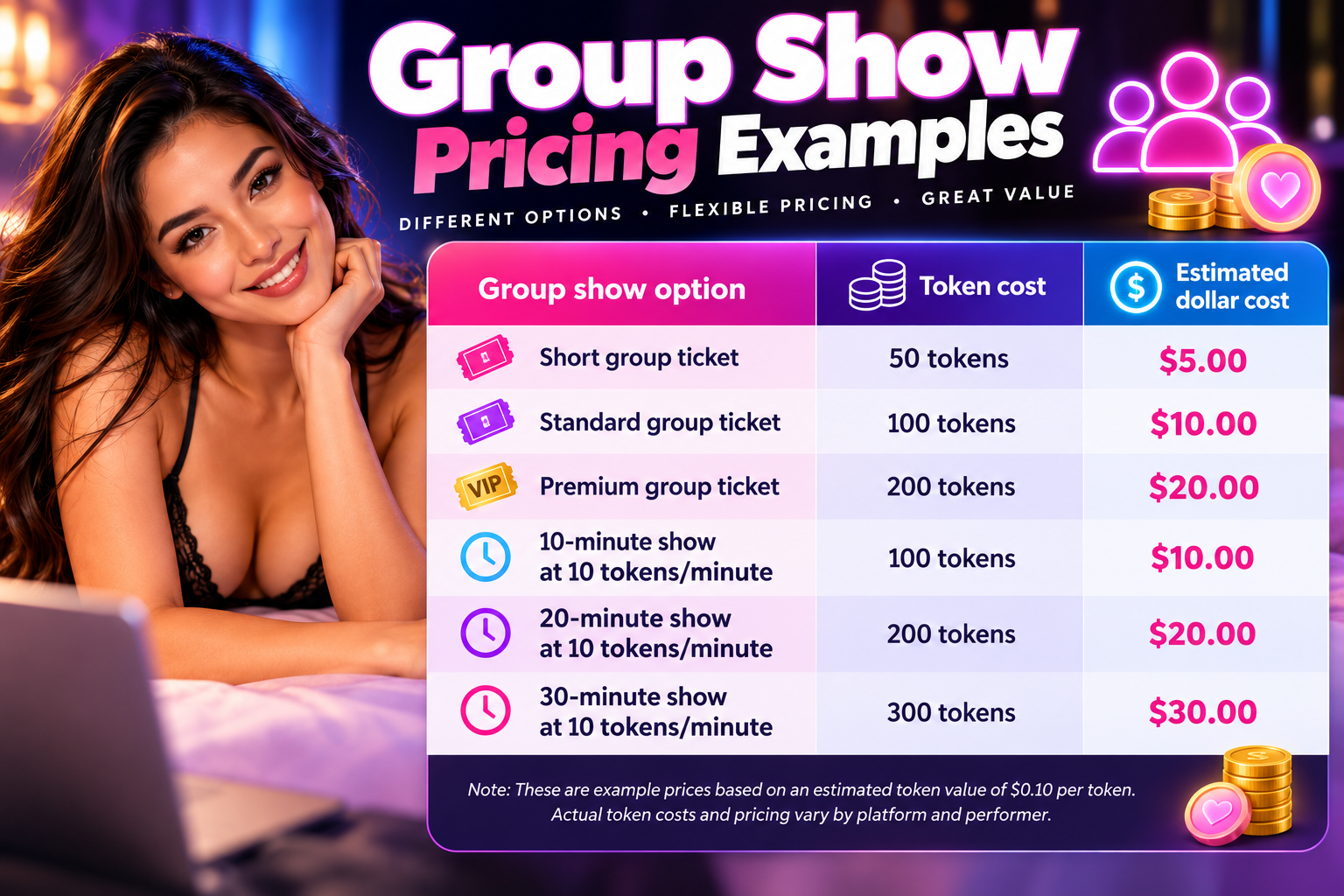
These are illustrative calculations, not published prices for a particular platform. Actual token costs, fees, and billing terms vary.
How to Calculate Your Actual Cost
For a ticketed session:
Total cost = Ticket price × Your cost per token
For a timed session:
Total cost = Tokens per minute × Minutes watched × Your cost per token
Suppose a performer charges 12 tokens per minute and you plan to watch for 15 minutes.
12 × 15 = 180 tokens.
If your purchased tokens cost $0.10 each, your estimated total would be $18.
This calculation excludes any additional tips, taxes, or applicable fees.
Are Tips Included in Group Show Prices?
Not necessarily.
Some group shows allow viewers to send optional tips during the broadcast. These contributions may support the performer, acknowledge an enjoyable experience, or count toward a separate announced goal.
Admission and tipping are different transactions. Paying to enter a room does not automatically mean every additional request or feature is included.
Before joining, determine whether the advertised amount covers the entire event, a specific period, or only admission to the session.
Group Shows vs Private Shows: What's the Difference?
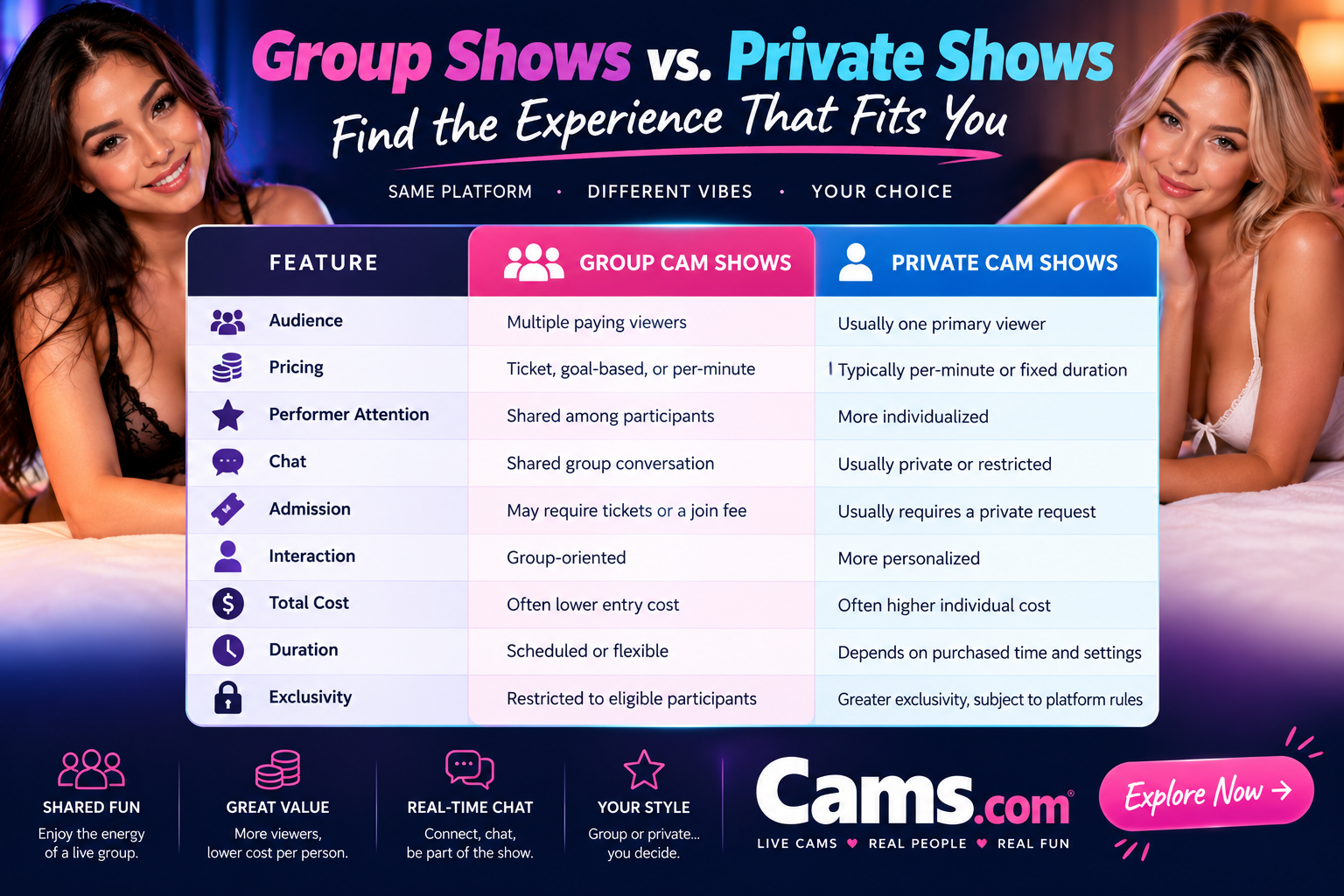
Choosing between group shows and private cam shows often comes down to what you value most: a shared social experience, predictable spending, direct interaction, or a more personalized session. Neither format is automatically the better choice. They serve different preferences and budgets.
Group shows can be particularly appealing to viewers who enjoy the energy of a shared audience. Private shows, meanwhile, are generally designed around more individualized attention. Understanding the trade-offs makes it easier to avoid paying for an experience that doesn't match your expectations.
When a Group Show Makes More Sense
A group show may be a better fit when you're exploring a performer's style, prefer a shared chat environment, or want to participate without paying for exclusive attention.
Ticket-based shows can also be attractive when the event has a clear duration and upfront price.
However, group sessions are not guaranteed to be cheaper in total. A lengthy timed show with additional tipping may cost more than a short private session.
When a Private Show Makes More Sense
Private sessions are better suited to viewers who prioritize individual conversation and focused interaction.
They can also offer more control over the direction of a session, within the performer's stated boundaries and platform policies.
Keep in mind that "private" does not always mean absolutely exclusive. Some websites permit additional paying viewers to observe certain private broadcasts through a separate viewing feature.
If exclusivity matters, check the exact privacy settings before purchasing.
How Live Cam Group Chat Works During a Show
The live cam group chat is often what makes group shows feel different from simply watching a paid video. Rather than consuming prerecorded content, participants can experience a broadcast as it unfolds and communicate within a shared environment. The conversation can become part of the event itself.
This interaction also introduces an important difference from private sessions: attention is shared. A performer may receive several messages at once, respond selectively, or focus on the overall group rather than individual requests. Understanding that dynamic helps set realistic expectations.
What Can You Do in a Group Webcam Chat?
Depending on the platform, participants may be able to:
· Send messages to the performer and other viewers.
· React to moments during the broadcast.
· Ask questions about the session.
· Send optional tips.
· Participate in announced interactive activities.
· View performer updates or event goals.
· Join or leave an ongoing session when permitted.
Not every group chat includes all these features. Some platforms restrict messaging to paying participants, while others may allow limited viewing of chat activity without access to the broadcast.
Group Chat Etiquette That Makes the Experience Better
The most enjoyable group sessions usually have a simple ingredient: participants respect the fact that they're sharing the room.
Avoid flooding the chat with repeated messages or demanding immediate responses. Other viewers have paid to participate too, and the performer may be managing multiple conversations simultaneously.
Respect stated boundaries, avoid sharing personal information, and remember that tips do not guarantee a particular response unless the performer and platform explicitly offer an agreed feature.
A friendly message and reasonable expectations generally contribute more to a positive experience than trying to dominate the conversation.
How Performers Organize and Run Group Shows
From the viewer's perspective, joining a group show may take only a few clicks. Behind the scenes, performers often make several decisions before the session begins. They may need to select a format, determine pricing, describe the event, schedule a start time, and decide how many participants are needed.
These choices affect the audience experience. A clearly organized event gives viewers more confidence about what they're purchasing, while vague descriptions or confusing payment terms can create frustration before the show even begins.
Planning the Event
A performer may begin by deciding whether the session will be a scheduled ticket event or an open-ended timed broadcast.
Ticketed events work particularly well when the performer wants to establish a defined start time and approximate duration.
Timed group shows offer greater flexibility because viewers may be able to join and leave while the broadcast is running.
Setting Prices and Participation Requirements
Performers generally consider the expected audience, duration, and type of interaction when establishing prices.
A lower admission price may encourage more participants, while a higher ticket price may be appropriate for a more limited event.
Some systems allow performers to establish a minimum participation target. Others permit sessions to begin with only one paying participant.
Managing the Live Experience
Once the broadcast starts, the performer manages the session while responding to viewers, monitoring chat, and deciding when to end the event.
Clear communication matters throughout. Viewers benefit from knowing whether the show is starting late, whether additional participants can enter, and when the session is approaching its conclusion.
The most reliable experience is one in which the advertised format, actual billing, and delivered session remain consistent.
How to Choose the Best Group Cam Show for Your Budget
A low ticket price can look appealing, but price alone doesn't determine whether a group show offers good value. Two sessions with identical admission costs may differ considerably in duration, interaction, and overall experience. A useful comparison considers what the payment actually includes.
Before committing, think about what you want from the session. Are you primarily interested in watching a live performance, enjoying group conversation, or interacting with a particular performer? Your answer will help you evaluate options without getting distracted by promotional descriptions.
Look for Clear Show Descriptions
A useful event listing should explain the format, approximate duration, price, and participation conditions.
Be cautious when a listing doesn't clearly distinguish admission from optional purchases.
The fewer assumptions you need to make, the easier it is to decide whether the event is worthwhile.
Compare Total Cost, Not Just Entry Price
Imagine two hypothetical shows:
Show A: A 150-token ticket for a scheduled 25-minute event.
Show B: A timed event charging 8 tokens per minute.
After 25 minutes, Show B would cost 200 tokens, making Show A less expensive for that viewing period.
However, if you only wanted to participate for 10 minutes, Show B would cost 80 tokens and could be the more economical option.
The lesson is simple: compare costs using the amount of time you actually expect to participate.
Check the Performer's Schedule and Communication
An established schedule and clear announcements can make a group session easier to plan around.
Review the available event description and any relevant profile information. Look for clarity about when the event begins and what happens if it is postponed or canceled.
If the details are unclear, waiting for another session may be preferable to making an uncertain purchase.
Privacy and Safety Tips for Live Webcam Shows
Privacy deserves attention whenever you participate in a paid online community, including live webcam shows. Even when a group session is restricted to paying viewers, that restriction does not automatically make the experience anonymous or guarantee that everything shared will remain private.
Your username, chat messages, payment activity, and account details may be handled differently across platforms. Taking a few precautions before participating can reduce unnecessary exposure and make the experience more comfortable.
Protect Your Personal Information
Use a screen name that doesn't reveal your full legal name, workplace, address, or other identifying details.
Avoid sharing personal contact information in public or group chat rooms. A conversation that feels informal is still taking place through an online service.
Check the platform's privacy policy to understand what information is collected and how it may be used.
Keep Payments Within the Platform
Use the website's supported payment system rather than sending money directly to unfamiliar individuals.
Off-platform payment requests can introduce additional fraud and privacy risks, particularly when they involve unverified links or personal payment details.
Also review whether token purchases, subscriptions, or other account features involve recurring billing.
Understand the Limits of Privacy
A restricted group broadcast is not the same as a confidential conversation.
Other paying participants may see your username and messages, and platform operators may retain information under their policies.
Never assume that other viewers cannot capture content simply because recording is prohibited.
Respect Consent and Boundaries
Performers are people managing their own work, schedules, and limits. Participation fees do not override their right to decline requests or end a session.
The same principle applies to other viewers. Avoid harassment, unwanted personal questions, and attempts to move conversations into private channels without consent.
Choose reputable platforms with accessible support, reporting tools, and clear policies for adult participation.

Common Group Cam Show Problems and How to Solve Them
Even a well-organized group show can encounter technical or payment issues. A broadcast might begin later than expected, a payment may not appear immediately, or a viewer might have trouble accessing a session after purchasing admission. These problems can be frustrating, especially when credits have already been deducted.
The best response is to identify whether the issue involves your account, the stream, the payment system, or the event itself. Avoid repeatedly purchasing admission or reloading tokens until you know what happened to the original transaction.
I Paid for a Group Show but Cannot Enter
First, confirm that the event has actually started.
Some ticketed sessions display a waiting screen until the performer begins broadcasting.
If the event is active, refresh the page once, check your account status, and review the transaction history. If access remains unavailable, contact the platform's support team.
The Group Show Was Canceled
Cancellation rules depend on the website and the payment structure.
Some platforms return ticket payments when an event doesn't proceed. Others apply different rules based on whether the show started or whether the viewer voluntarily left.
Check the specific refund policy rather than assuming all canceled events receive identical treatment.
My Tokens Are Disappearing Faster Than Expected
You may be participating in a per-minute show rather than a fixed-price event.
Check the displayed billing rate and whether additional tips or purchases were made.
If the deductions don't match the published terms, leave the session and review your transaction history before contacting support.
The Stream Keeps Buffering
A weak internet connection, browser extension, overloaded device, or temporary platform problem can interrupt playback.
Try closing unnecessary tabs, checking your connection, or using a supported browser.
For a timed paid session, leave the room if necessary rather than allowing charges to continue while troubleshooting.
The Performer Ended the Show Early
Live events can end unexpectedly because of technical difficulties, scheduling issues, or the performer's decision.
Whether you qualify for a refund depends on the platform's terms and the circumstances.
Document the event time, transaction, and relevant support information if you believe the service did not match its advertised conditions.
Are Group Cam Shows Worth It?
Whether group cam shows are worth paying for depends less on the number of viewers and more on the experience you're seeking. If you enjoy shared conversation, live interaction, and a lower barrier to entry than many private sessions, a group format may be appealing. If you prefer uninterrupted individual attention, the same experience could feel less satisfying.
Value also depends on predictability. A clearly priced ticketed event may be preferable to an open-ended session when you're working with a fixed budget. Conversely, a pay-per-minute group show may make more sense if you only want to participate briefly.
Who Gets the Most Value From Group Shows?
Group shows can suit viewers who enjoy community-style interaction and don't expect every message to receive a personal response.
They're also useful for people who want to learn how a performer's live sessions operate before considering a more individualized experience.
Exploring live webcam shows can help you understand the broader range of interactive broadcasting formats. Check the current features and payment terms of any specific show before participating.
When Another Experience May Be Better
Not everyone wants a shared broadcast.
Some viewers prefer the direct communication associated with private cam shows. Others are more interested in meeting people, building connections, or participating in an online community than watching a scheduled performance.
For those interested in the social side of adult online interaction, adult friendfinder offers a different type of experience centered on member profiles and connections.
The important distinction is purpose. A group cam show is primarily a shared live event, while a dating or social community serves broader relationship and communication interests.
What to Know Before Joining Your Next Group Cam Show
Group cam shows occupy an interesting middle ground between free public broadcasts and private one-on-one sessions. They give multiple viewers access to a shared paid experience, often with live conversation and opportunities to interact with the performer. The format can make participation more accessible, but its real value depends on the show's structure, pricing, and your expectations. Understanding those details before joining is more useful than simply looking for the cheapest advertised ticket.
The biggest practical lesson is that not all group shows are billed the same way. A ticket-based event may provide a fixed admission price, while a timed show charges according to how long you stay. Goal-based events can introduce additional conditions before the broadcast begins. Knowing which model you're purchasing helps you calculate costs, plan your time, and understand what happens if a session is delayed or canceled.
It's equally important to recognize what you're paying for. Group participation usually means sharing the performer's attention with other viewers. That can create a lively, interactive atmosphere, but it also means individual requests may not receive immediate responses. Private sessions offer a different balance of attention, exclusivity, and cost. Neither is inherently better; the right choice depends on whether you value group interaction, individual communication, flexibility, or predictable spending.
Before your next session, check the advertised price, convert tokens into their actual dollar value, review the event rules, and decide how much you're comfortable spending. Choose platforms with transparent billing, clear privacy policies, and accessible customer support. Most importantly, approach the experience with realistic expectations and respect for everyone involved. When you understand how group shows work before entering the room, you're better equipped to choose an event that matches your interests, budget, and comfort level.
Additional FAQs: What Is a Private Cam Show?
Can you watch a group cam show without paying?
Most group cam shows require payment to watch the restricted broadcast, although some platforms let visitors preview the public room before the paid session begins. Viewers may also see event announcements, countdowns, or limited chat activity without purchasing access. Free previews and paid admission are separate features, so check the show's access requirements before joining.
How many people can join a group cam show at once?
The number of participants depends on the platform and the performer's settings. Some group webcam shows allow many paying viewers to participate simultaneously, while others may have attendance limits or minimum participation requirements. A group show does not necessarily have a fixed audience size, and the number of participants may change throughout the broadcast.
Can you join a group cam show after it has already started?
Yes, many live cam platforms allow viewers to enter an ongoing group show, provided admission remains available. Depending on the payment model, you may purchase a ticket or begin paying a per-minute rate when you enter. Joining late usually means missing earlier portions of the broadcast, so check whether the admission price changes or remains the same.
Can you rejoin a group cam show without paying again?
Some ticket-based group shows allow participants to leave and return using their original admission, as long as the event is still running. Per-minute shows generally resume charging when viewers reenter. Reentry policies differ between platforms, so check whether your original payment provides continued access or whether another charge applies.
Do group cam shows start automatically when enough viewers join?
Not always. Some group shows begin when a specified ticket or token goal is reached, while others start at a scheduled time or when the performer activates the session. Certain platforms also allow performers to begin even when a participation target has not been met. The event announcement should explain whether the start depends on a countdown, funding goal, or performer decision.
Can other viewers see your username during a group cam show?
In many group webcam chat rooms, paying participants can see the usernames of people posting messages, and some platforms also display participant lists. Your real name generally does not need to appear unless you have included it in your profile or username. For greater discretion, choose a screen name that does not reveal personally identifying information.
Do you need a webcam or microphone to participate in a group show?
No, most viewer-oriented group cam shows do not require you to activate your own webcam or microphone. You can typically watch the performer and communicate through text chat. Some platforms offer optional two-way audio or video features, but these are separate capabilities that may require additional permissions. Check your device settings before enabling them.
Can group cam shows be watched on a smartphone or tablet?
ny modern live webcam platforms support group shows through mobile browsers or compatible applications. However, certain interactive features may work differently on mobile devices than on desktop computers. A stable internet connection, updated browser, and sufficient battery life can help reduce interruptions. Before purchasing access, confirm that the platform supports paid group sessions on your device.
Can you watch a recording of a group cam show after it ends?
Some platforms offer recordings of selected group shows, but replay access is not automatically included with admission. Recordings may be available as a separate purchase, a performer-controlled feature, or not at all. If you want to watch the session again, verify whether an authorized replay is offered and whether it involves an additional charge.
What happens if your tokens run out during a group cam show?
During a pay-per-minute group show, running out of tokens may cause the platform to end your paid access automatically. In a ticket-based event, admission may remain valid for the purchased session even if your remaining balance reaches zero. The exact behavior depends on the billing system, so monitor your token balance and understand the show's payment terms before entering.
Recent Articles